



The rules around whether companies are considered dormant or active can sometimes seem confusing, particularly because Companies House and HMRC have different definitions of what a “dormant company” is.
In this guide, we’ll explain how to know if your company is considered dormant or active, what each status means for compliance, and what to do if your status changes.
Key takeaways
- HMRC considers a company dormant if it is not trading. Meanwhile, Companies House considers a company dormant if it has no significant accounting transactions.
- To make a company dormant, you must cease all financial activity and notify HMRC of its dormancy for Corporation Tax purposes.
- Dormant companies must still submit annual accounts, confirmation statements, and company changes to Companies House to remain compliant and avoid penalties.
What happens after you have formed your company
Firstly, congratulations on registering your company! Many new founders often wonder if their company is active or dormant. This is an important question because it’s essential to understand the necessary steps to ensure your company is “active” and to be aware of your reporting obligations.
Why is my company’s status listed as active at Companies House?
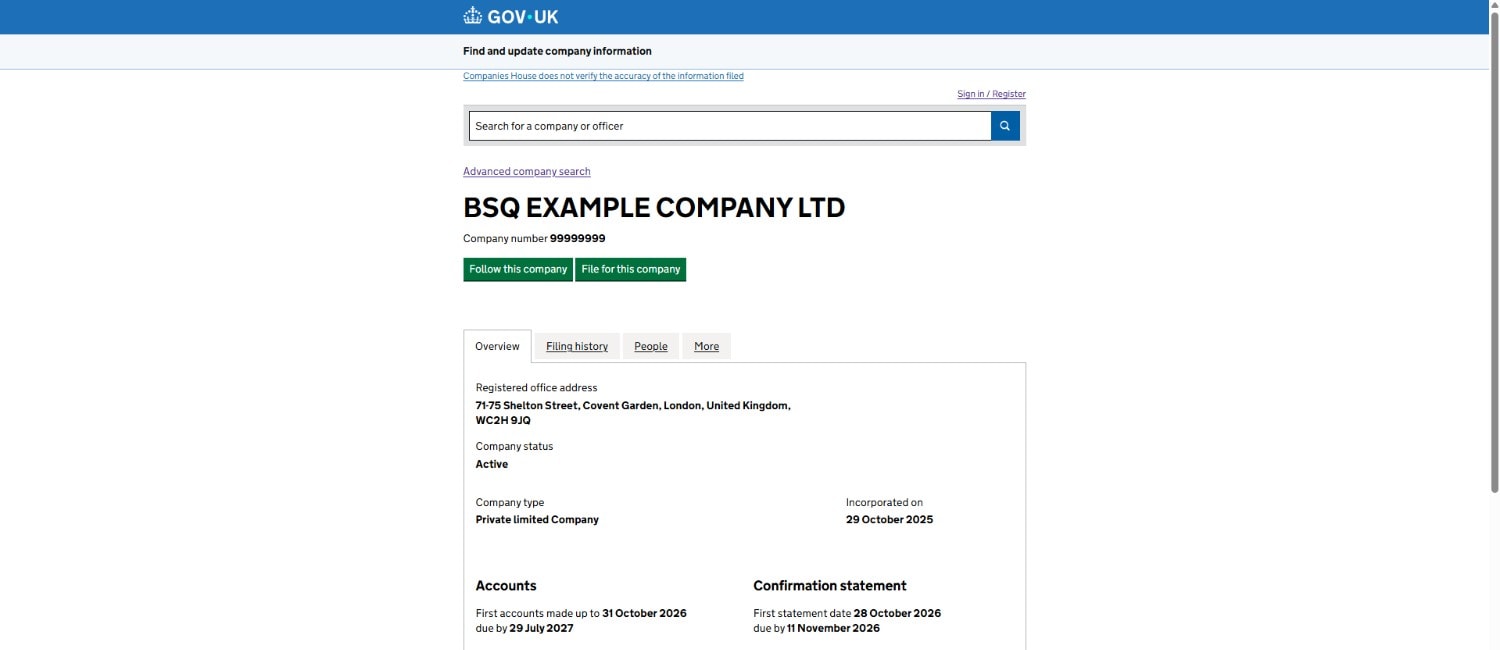
As soon as you register your company, it will be listed as an active company at Companies House as “active.” This simply means the company is in existence and has not been dissolved or closed down. It provides no indication as to whether the company is doing anything.
The role of the Standard Industrial Classification codes
During the formation process, you were asked to provide between 1 and 4 Standard Industrial Classification (SIC) codes, which tell Companies House the nature of your company’s activities. You may have chosen the dedicated SIC code for a dormant company, code 99999.
- What is a SIC code and why does my company need one?
- Company filing and reporting requirements
- VAT terms you should know as a UK business owner
However, you must remember that SIC codes are not legally binding and do not automatically make a new company dormant. They are purely informative, allowing Companies House to maintain an accurate record of all registered companies’ activities, and for anyone else searching your company to get an idea of what it’s up to.
How to make a company dormant: Step by step
Have you ever wondered why you might want your company to be “dormant” after its incorporation? There are several reasons for this decision. For example:
- You are reserving the company name so that someone else cannot take it
- You have registered a company for a future project you haven’t started
- You have stopped trading, but you are keeping the company in case you decide to restart in the future
For example, Jane registers a limited company in June 2026 to secure the name “Jane’s School Photography Limited”, with plans to launch her photography business in September 2027. However, she doesn’t take on any clients, purchase stock, or open a business bank account in the meantime. She therefore places the company into a state of dormancy until she needs it again.
Definitions of dormancy: HMRC vs Companies House
To learn how to make your company dormant, we must first understand what a “dormant company” is. There are two definitions that are important for this – those provided by Companies House and HMRC.


HMRC is the government department responsible for collecting taxes. They define a dormant company as one that’s not trading (i.e., it’s not conducting any business or engaging in any activities).
Companies House, meanwhile, is the UK’s registrar. Their job is to register new companies and make information about them publicly available. They define a dormant company as one that has had no significant accounting transactions throughout its financial year.
Let’s explore what these definitions actually mean by looking at how we let HMRC and Companies House know your company is dormant.
How to notify HMRC that your company is dormant
HMRC classifies a dormant company for Corporation Tax purposes as one that’s not trading. This is a broad statement, but essentially means the company’s not doing anything and has no other income, like investments.
You can tell HMRC you’re dormant as soon as you receive your Unique Taxpayer Reference (UTR) number from them. This arrives within 3 weeks of incorporation.
You must then notify HMRC that your company is dormant, either online or in writing. If you want to inform them in writing, we’ve created a free Dormant Company Notification Letter Template to help you with this step.
Once HMRC has accepted your notification, your new company won’t be required to prepare a Corporation Tax return or pay Corporation Tax until it starts trading. Do not assume HMRC considers your company dormant until you receive confirmation directly from them.
HMRC may ask you to confirm this again in a few years’ time, to ensure your company continues not to trade.
How to notify Companies House that your company is dormant
There is no specific procedure for declaring your new company dormant. Indeed, you don’t really “notify” them at all. Your filings, specifically your accounts, will instead show Companies House, and anyone looking, that your company is dormant.
As we mentioned, Companies House defines a dormant company as one that has had no significant accounting transactions during the accounting period, as defined by Section 1169 of the Companies Act 2006. A significant accounting transaction is any transaction that requires entry in the company’s books. It does not matter how big or small the transaction is (for example, it could be as little as 1p) or where it came from (for example, it could be an interest payment).
The only transactions that aren’t considered significant are:
- Payments received from the initial shareholders of the company for their shares taken up at incorporation
- Fees paid to Companies House (for example, the confirmation statement filing fee)
- Late filing penalties to Companies House for the annual accounts
If your company meets this definition, it may be eligible to submit dormant company accounts. These are a simplified form of annual financial statements, which are far quicker and easier to submit. By submitting these or comparable accounts, you are showing Companies House you are dormant.
For additional transparency, you could also change your company’s SIC codes to 99999 (indicating a dormant company).
Making a dormant company active
Let’s now look at how you turn your dormant company into a non-dormant one.
Tell HMRC your company is now active
Once you have started trading, you have three months to notify HMRC. This is done by registering for Corporation Tax and providing the following information:
- The company’s registered name and number
- The Unique Taxpayer Reference (UTR)
- The date you started trading
- Primary business address
- A description of what the company does
- Accounting reference date – this is the last date of your financial year. Learn more about your accounting reference date.
Once registered, you’ll need to work out your Corporation Tax liability and pay your bill every year.
Tell Companies House your company is now active
As before, you don’t really “notify” Companies House of your company’s trading status. Instead, when the time comes, you simply file the relevant annual accounts to Companies House. So, when your company becomes active, you’ll file accounts that are not dormant company accounts.
The exact contents of your accounts depend on the size of your company. In any case, it will be clear that your company is no longer dormant.
If your company’s SIC codes are 99999 (dormant company), you should also update them to suitable codes that reflect your company’s current activities.
Additional requirements
When making a dormant company active, you might also need to register for Value-Added Tax (VAT). This will apply if the company’s taxable turnover exceeds £90,000 in a 12-month period or is expected to exceed this amount within the next 30 days.
Additionally, if you currently employ staff (or are about to), you’ll need to register as an employer with HMRC and set up a payroll system.
Reporting requirements for active companies
The reporting requirements for an active company’s accounts are different from those for a dormant one. The information you must report to Companies House on the accounts normally depends on the company’s size.
As a general rule, companies need to submit full accounts to Companies House, consisting of the following:
- Profit and Loss Account
- Balance sheet
- Supporting notes
- Directors’ report
- Auditor’s report
- A director’s name and signature
However, micro and small companies can file abridged accounts containing a balance sheet and supporting notes, meaning the actual content and requirements of their annual accounts may be smaller.
Active companies must also submit an annual confirmation statement and details of any other changes (such as new directors or shareholders) to Companies House.
Change from active to dormant if you have traded before
If you’ve traded for some time and wish to make your company dormant, you can change your trading status in a similar manner to what we examined earlier.
1. Stop trading
To be considered dormant, your company must actually meet the definition of dormancy, as defined by both Companies House and HMRC. This means you must stop all trading and ensure that no further significant accounting transactions occur.
2. Notify HMRC that your company is dormant
You need to tell HMRC that your company is dormant for Corporation Tax purposes. You will need your company’s name, UTR, and the date it ceased trading to complete this step. HMRC will then send you a “Notice to Deliver a Company Tax Return” to your registered office address, instructing you to file a final tax return and accounts for the period leading up to the date the company stopped trading.


If you are also VAT-registered, you’ll need to cancel your registration within 30 days of the company becoming dormant. The easiest way to do this is via your VAT online account.
3. Submit your accounts to Companies House
When the time comes, you should submit accounts that reflect the company’s dormancy to Companies House. You may need to submit another set of accounts reflecting that you traded for part of the accounting period first. Thereafter, assuming you remain dormant, your future accounts will then fully reflect your dormancy status
Reporting requirements for dormant companies
Whilst a company is dormant, and you have already informed HMRC of this status, you must still make certain filings to Companies House.
- Confirmation statement – This filing serves several purposes, including verifying that the details about your company are still accurate (such as the names of your shareholders). You must file at least one confirmation statement every 12 months.
- Annual accounts – You must submit these for each financial year. Most companies will be able to submit dormant company accounts.
- Any other changes to the company – If there are any changes to the company’s details, such as a change in the company’s registered office address or directors, these must be reported to Companies House as soon as they occur.
Checklist: Is my company dormant?
Use this short checklist to help ensure your company’s dormant.
- Your company has not received any income (e.g. bank interest, investment income, etc.)
- Your company has not made any payments (e.g. settled an invoice, paid rent, etc.)
- Your company has no other significant accounting transactions
- Your company is not carrying out any other activity (e.g. running a website, marketing its services, etc.)
- You have informed HMRC that your company is dormant for Corporation Tax purposes
- Your company has submitted, or will submit, dormant company accounts to Companies House
- Your company has submitted, or will submit, its annual confirmation statement to Companies House
- Your company’s details are up to date at Companies House
- Optional: Your company’s SIC code is 99999 (dormant company)
Remember, Companies House won’t label your company as dormant. However, its dormancy will instead be reflected in its filings.
Register your company and stay compliant with Rapid Formations
The difference between dormant and active company status depends on whether the business is trading or engaging in any financial activity, as defined by HMRC and Companies House. However, whether your company is active or dormant, you still need to file confirmation statements, submit annual accounts, keep Companies House up to date with your company’s details, and keep HMRC informed if your trading status changes.
Understanding this is vital. Many new company owners assume that if their business is dormant, they have no filing responsibilities. However, this is not the case. Staying compliant helps avoid unnecessary penalties and keeps your company in good standing.
If you’re ready to set up a company, whether to trade immediately or to keep dormant for future plans, you can register your company quickly and easily today.
Want to keep your dormant company in good standing? Our Hassle-Free Compliance Service handles all key filings, so you don’t have to worry.





Join The Discussion
Comments (2)
I’ve just retired and I’m no longer trading. However, I’m keeping the Company and I will still pay monthly bank fees, ICO fee, accountancy fees and Rapid Formations Service Address renewal fees. Would these constitute significant account transactions and that the Company is ‘Active’ despite the fact that it’s not trading?
Hi Steven,
Thank you for your kind comment.
Dormant according to Companies House:
Your company is called dormant by Companies House if it’s had no ‘significant’ transactions in the financial year.
Significant transactions don’t include:
filing fees paid to Companies House
penalties for late filing of accounts
money paid for shares when the company was incorporated
Kind regards,
The Rapid Formations Team.