


Does a teenager you know want to start a business? If they’ve come to you with an idea, they’re part of a massive trend that’s only accelerating. 61% of Gen Z in the UK are already earning from side hustles, and three-quarters want to start one.
From there, the sky is the limit, with teenagers now regularly running highly successful businesses alongside their education and social lives.
The challenge is often understanding how to encourage their ambition while also helping them make sensible decisions. It’s nothing you can’t master with some time, patience, and support.
This guide is for supportive adults who want to help a teenager pursue their business aspirations. It covers how to start a business as a teenager in the UK – the legal and financial sides, plus helpful resources to tap into.
Key takeaways
- There’s no minimum age to start a business as a sole trader in the UK.
- From the age of 16, teens can register a limited company and be a director.
- Parents and guardians often need to handle banking, contracts, and tax registration – many of which require adults.
- Resources such as business books, mentorship, and enterprise programmes support young founders.
Why teens have a unique advantage in business
Teenagers have a unique edge: time. Time to explore, experiment, and even to fail without significant repercussions. No mortgage, fewer responsibilities, and relatively little to lose.
By running their own venture, young people gain skills such as selling, negotiating, managing money, communicating with strangers, and handling professional challenges.
For teenagers who are unsure what they want to do, running a small business is one of the fastest ways to find out. They discover what energises them, what bores them, and what they’re willing to work at to succeed and find satisfaction.
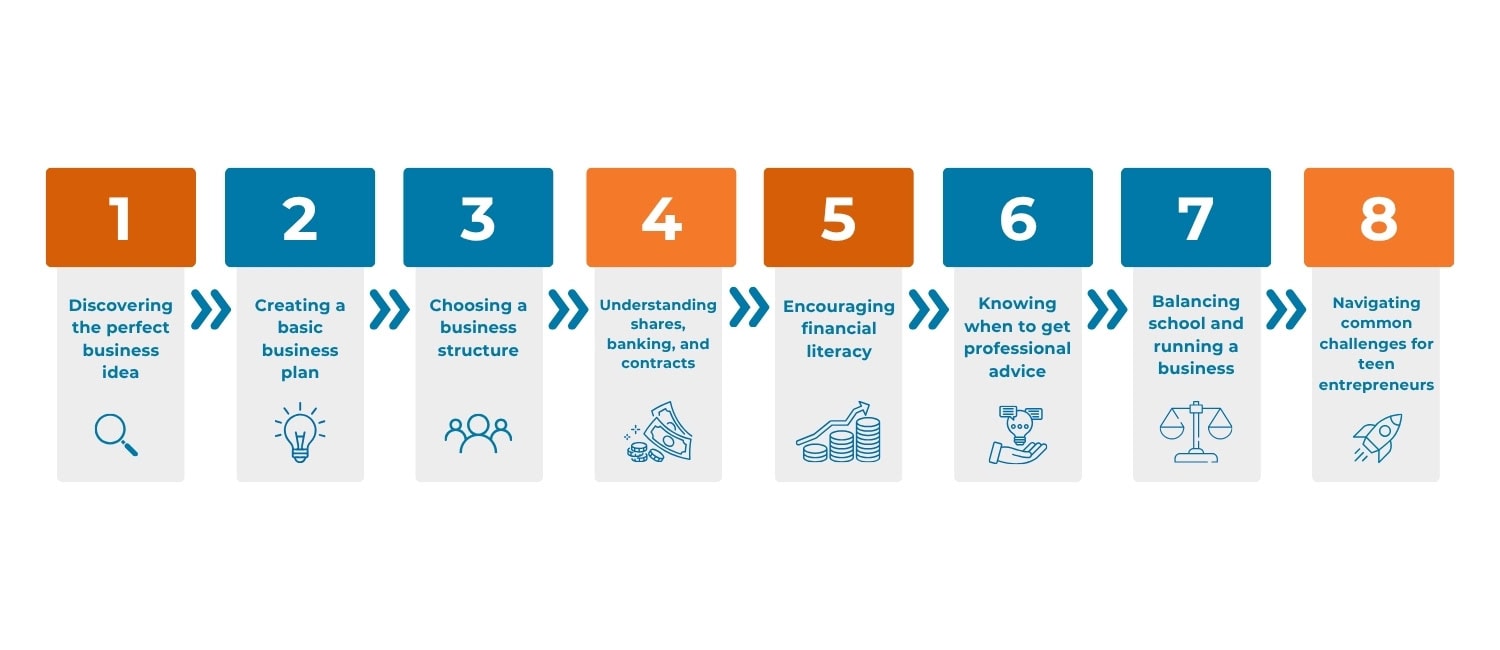
Step 1: Discovering the perfect business idea
Identifying a good idea starts with your teen’s existing passions or skills. Start by sitting down and discussing:
- What are they good at? Design, coding, writing, baking, persuading people with their passionate ideas – almost any skill becomes a business for teens with the right setup
- What do they actually enjoy? Ideas built around genuine interest last longer than those picked purely for profit
- How much time can they commit? Some models need daily attention, while others suit a few hours on the weekend
- What’s the budget? Many teen businesses launch for under £50, and some cost nothing at all
Business ideas worth exploring
From there, look at what other young people are already doing. Popular options include:
- Graphic design, video editing, or social media management
- Tutoring other students in subjects they’re strong in
- Selling handmade or customised products online
- Print-on-demand, which means designing products without holding stock
- Dog walking, car washing, or gardening
- Reselling second-hand or vintage clothing on Depop or Vinted
- Content creation on YouTube, TikTok, or through podcasting
- Tech and digital, such as building apps, websites, or other technologies
Step 2: Creating a basic business plan
A basic business plan provides structure without being exhaustive – nobody needs a formal 30-page document at this stage. Write down a few questions to provide some structure and identify gaps ahead of spending money. An initial business plan should cover:
- What are they selling? A clear description of the product or service
- Who’s buying it? Age, interests, and where they spend time online
- How will people find them? Social media, word of mouth, marketplaces, and local advertising
- What does it cost to start? Materials, tools, platform fees, and packaging
- How will they price it? Research comparable products, factor in costs and time, and make sure there’s a margin
Putting the proverbial pen to paper helps a teenager think everything through in detail. It also gives you, as a parent or guardian, a clearer idea of what kind of support they may need – whether that’s financial, practical, or just moral.


Step 3: Choosing a business structure
This is where parental or adult support is essential. There are decisions to make about structure, tax, contracts, and banking, and many of these steps require an adult’s involvement.
One of the first choices is whether to begin as a sole trader or form a limited company. Here’s an overview of both options.
Sole trader
Starting a business as a self-employed sole trader has no minimum age or formation costs.
If they earn more than £1,000 in a tax year, they’ll need to register with HMRC for Self Assessment. Below that threshold, the trading allowance means they usually won’t need to file a return. Here are the basics:
- No legal separation – there’s no divide between them and the business. If a customer disputes a payment or a supplier chases a debt, there’s no legal barrier between that obligation and their personal savings
- Record-keeping from day one – they need to track every pound coming in and going out
- Income Tax – usually applies once taxable income exceeds the Personal Allowance (£12,570 for 2025/26)
- National Insurance – Class 4 contributions apply if self-employed profits exceed £12,570 for 2025/26
For most younger teenagers, being a sole trader is a natural starting point in business. Once they turn 16, forming a limited company becomes an option.
Limited company
From the age of 16, a teenager can be the director of a limited company that they form themselves. This means that forming their own limited company and being a shareholder of it becomes an option.
A limited company is its own legal entity – separate from the person who set it up. This means that if the business runs into financial trouble, the shareholders’ liability is limited to the value of their shares – and if a director is also a shareholder, that protection extends to them too. However, directors can be held personally liable in certain circumstances – for example, if the company continues trading while insolvent.
Rather than keeping income directly as a sole trader would, the director-shareholder gets paid through the company, usually as a combination of salary and dividends.
The trade-off is more admin. For example, each year, a limited company must file and report:
- Annual accounts – a financial summary of the company’s income, expenses, assets, and liabilities, filed with Companies House
- A confirmation statement – a yearly check confirming that the company’s details on the public register – directors, registered address, shareholders – are still correct
- A Company Tax Return – a report filed with HMRC showing the company’s taxable profits and how much Corporation Tax is owed
- Changes to company details – any updates such as appointing a new director, changing the registered address, or issuing new shares must be reported to Companies House
If income is growing and a 16+ teenager wants more structure and protection, this can be a logical move.
A limited company also opens up options for how they pay themselves – such as a combination of salary and dividends – which can be more flexible as profits increase. A company registration agent can handle the setup and get everything registered with Companies House.
- Can an international student start a business in the UK?
- How to protect your privacy when starting a business
- Best business ideas for UK teens in 2026
Directors and running the company
A director is the person legally responsible for managing a company and making decisions on its behalf. The full role and responsibilities apply regardless of age or experience. These include:
- Acting in the company’s best interests at all times
- Exercising reasonable care and skill in running the business
- Avoiding conflicts of interest between personal affairs and the company’s
- Filing annual accounts and a confirmation statement with Companies House on time
- Filing a Company Tax Return with HMRC each year
- Keeping proper records of all transactions
Missing these obligations carries real consequences. Late filings result in personal fines. In more serious cases, a court can disqualify a director for up to 15 years or, in the most extreme cases, even impose a custodial sentence (a prison sentence). And if the company trades while insolvent, directors can be held personally liable – meaning the company’s debts become their personal debts, payable from their own money and assets.
If a parent or guardian becomes a co-director
If the child is over 16 and can be a director themselves, a parent or guardian may choose to join as a second director to share the responsibilities of running the company.
This is useful for signing contracts, opening a business bank account, and other steps that generally require someone to be 18 or older.
Anyone considering this role should understand what it involves. A co-director carries the same statutory duties and legal responsibilities as any other director, including everything listed above. Both directors are equally accountable.
Step 4: Understanding shares, banking, contracts, and VAT
Starting a business also means understanding the rules around ownership, banking, and agreements. For teenagers, there may be extra restrictions, as banks, payment providers, and some contracts often require an adult to be involved.
Shares and ownership
Shares represent ownership of a company – if you own shares, you own a piece of it. There’s no minimum age to own shares, so even someone under 16 can normally be a shareholder (though this can pose its own challenges). The company just needs at least one director who meets the age requirement.
That said, parents may sometimes choose to hold the shares in the company on behalf of the minor through a trust. A trust is a legal arrangement in which a person or persons – the trustees – hold and manage an asset on behalf of another person – the beneficiary. In this case, the parent is the trustee and the child is the beneficiary.
A common type used here is a bare trust. This is the simplest type, in which the trustees hold the assets until the beneficiary is old enough to take ownership. Once the child turns 18, they would transfer the shares to them.
Because trusts involve legal responsibilities and tax implications, getting proper legal advice before setting one up is essential.
Contracts
Until a teenager turns 18, the contracts they sign may not be legally binding. Minors can generally walk away from contracts that aren’t for “necessaries” (essential goods and services), which is why suppliers and platforms are often reluctant to deal with them directly.
For anything involving regular payments or long-term commitments, a parent or guardian may need to sign or co-sign.
Banking
Limited companies need a dedicated business bank account, and many banks require all directors and account signatories to be at least 18 years old.
If the parent or guardian is a co-director, they can sometimes open and operate the account for the company. It’s still worth speaking to the bank directly to confirm their specific policies and understand exactly what being an account signatory involves for you.
Some digital banks (Starling, Monzo, Revolut, etc.) may be more flexible on age requirements, though this varies, and you’ll need to read the T&Cs carefully.
VAT
VAT applies to businesses regardless of the owner’s age or their business structure – sole trader or limited company.
If your teenager’s business turnover reaches £90,000 in any rolling 12-month period, they’ll need to register for VAT with HMRC and start charging it on their sales. It’s also possible to register voluntarily before hitting that threshold, which can make sense if the business is spending heavily on materials or equipment, since it allows you to reclaim VAT on those costs.
Most teen businesses won’t be anywhere near the threshold early on, but it’s good to be aware of it. Keeping accurate sales records from the start makes it easy to track, and an accountant can flag when it becomes relevant.
Step 5: Encouraging financial literacy
Financial literacy is invaluable. Earning, spending, tracking, and making financial decisions are brilliant life skills for teens to learn.
The key areas are:
- Income and expenses – tracking what comes in and what goes out, even when the numbers are small at first
- Pricing – setting prices that cover costs, account for time, and leave a healthy margin
- Tax basics – understanding when to register with HMRC, what the £1,000 trading allowance means, and what records HMRC expects them to keep
- Saving and reinvesting – putting some profit back into the business to help it grow, rather than spending everything immediately
Step in with guidance when something needs explaining or when a decision has potentially serious consequences, such as filing tax returns, paying tax owed, or making large payments to other businesses or services.
Step 6: Knowing when to get professional advice
Knowing when to ask for help is a sign of good judgement for business leaders of all ages. As a parent or guardian, part of your role is recognising moments where professional advice is worth the investment:
- Self-employed income in one tax year nearing £1,000 – if you’re unsure what they owe or how to report it, a one-off conversation with an accountant can clear this up quickly
- Contract requests – if a client, supplier, or platform asks them to sign something with ongoing commitments, have a solicitor review anything complex and co-sign where needed
- Hiring someone – even casually or informally, employment law applies regardless of business size
- Collecting customer data – whether through a website, email list, or order form, data protection rules apply to sole traders and limited companies alike under UK GDPR
Step 7: Balancing school and running a business
A business shouldn’t overshadow education. Balance is key, and if a child is under 16, they’re legally required to be in full-time education in the UK.
That said, plenty of young entrepreneurs run successful ventures alongside school. The key is keeping the workload realistic:
- Set boundaries together – agree on how many hours per week go toward the business, and when those hours happen
- Treat it like any other commitment – block the time and stick to it, rather than letting business bleed into homework time or sleep
- Watch for burnout – slipping grades, broken sleep, or constant stress are all signs that something needs to give
- Encourage batching – doing all social media posts in one sitting or packing all orders on one evening is far more efficient than doing bits and pieces throughout the week
Step 8: Navigating common challenges for teen entrepreneurs
Setbacks are a part of business, so it’s a good idea to be prepared for some of the more common sticking points:
- Not being taken seriously – some adults underestimate young entrepreneurs. Encourage them to let their work speak for itself and to present themselves professionally in every interaction.
- Banking and payment barriers – many services may deny non-18+ account holders, so be prepared to step in where needed.
- Slow starts – most businesses take time to gain traction, so help them measure progress in small wins rather than just revenue and remind them that momentum builds gradually.
- Criticism and rejection – a negative review or a product that doesn’t sell can feel deeply personal, especially as a teenager. Help them treat feedback as data they can learn from.
- Imposter syndrome – feeling like they don’t belong in “business” is common among young entrepreneurs. Remind them that every successful founder started somewhere, and many of the best started young.
- Lack of working capital – teenagers rarely have savings to fall back on, and traditional finance like loans and credit cards won’t be available to under-18s. Help them start small, keep costs low, and explore alternatives like family support, grants from youth enterprise programmes, or pre-orders to generate revenue before they invest.


Resources and support for young founders
There’s no single route into entrepreneurship, but the right support can make the journey easier. Books, programmes, and specialist guidance can all help young people turn ideas into action. Here’s an overview of what’s out there.
Business books for teens
Here are four popular business books for teens that all cover different ground:
- The 7 Habits of Highly Effective Teenagers by Sean Covey – more personal development than business, but an excellent foundation for building confidence, discipline, and time management before starting anything commercial.
- Start It Up by Kenrya Rankin – the most hands-on option. Workbook-style with checklists and exercises that walk teenagers through starting a business step by step. US-focused and published in 2011, so some platform advice is dated, but the framework is solid.
- Young and Mighty by Henry Patterson – written by a UK teenager who launched Not Before Tea at nine. Includes 30 practical ways to earn money, plus contributions from Richard Branson, Theo Paphitis, and Instagram co-founder Mike Krieger.
Enterprise programmes and funding
There are many programmes designed to support young founders with training, mentoring, and, in some cases, funding:
- Young Enterprise runs the 10x Challenge for 11 to 19-year-olds – a £10 pledge, four weeks, and a real business to build from scratch, among their other support programs
- The King’s Trust Enterprise Programme supports 18 to 30-year-olds with workshops, mentoring, and access to grants of up to £5,000 and loans of up to £25,000
- Innovate UK Young Innovators provides funding, mentoring, and a network of young innovators, particularly for ideas in sustainability, tech, and social impact
- Launch It supports 18 to 30-year-olds from underserved backgrounds with workspaces, training, and funding
- Ultra Education runs entrepreneurship clubs and workshops for 7 to 18-year-olds, with a focus on underrepresented communities
School and college support
Many schools, colleges, and universities also run their own enterprise initiatives – business plan competitions, mentoring from local business owners, startup grants, or dedicated enterprise teams.
It’s worth checking what’s available. Older teens might also find it useful to consider running a side hustle while at uni.
It’s never too early to start a business
Supporting your teen’s entrepreneurial endeavours arms them with skills and confidence that extend beyond business.
As they bring energy and ideas, you provide structure and safety. Whether they start as a sole trader or register a company, these early experiences will set them up for success in future ventures.
When the time comes to register a company, Rapid Formations can take care of the company registration and Companies House paperwork so you can both focus on what matters.




Join The Discussion